Fish Robotics, Biomimetics & Mechanical Design |
Fish robotics is a major theme of research in our laboratory where we have developed a variety of robotic test platforms to examine fin and body kinematic and hydrodynamic function during locomotion. Robotic devices have the considerable advantage over studying live fish by allowing a variety of programmable motions that permit investigation of discrete components of naturally coupled movements. A key aspect of the mechanical design of these test platforms is that they are self-propelled and can swim against oncoming flow (and thus maintain station) in our recirculating flow tanks. An overview of our approach can be found in Lauder et al. (2007), and other papers relevant to this topic include Lauder and Madden (2006) and Tangorra et al. (2007). |
a.jpg)
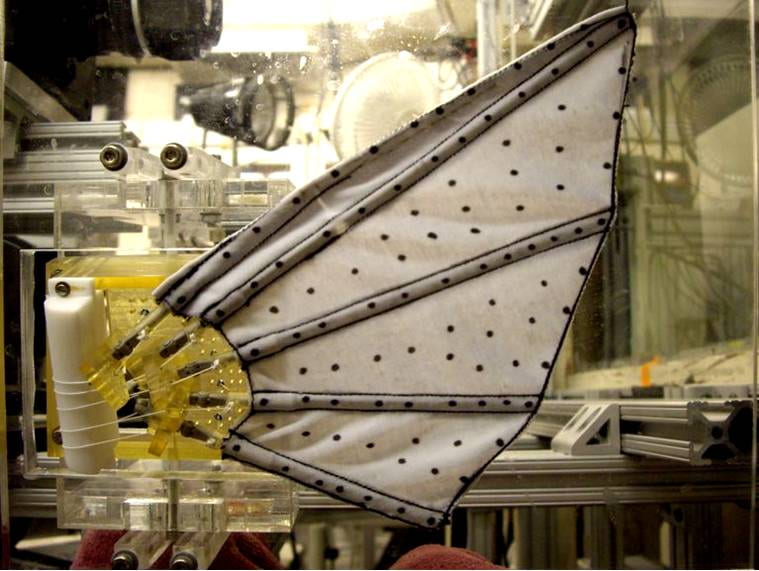
Latest generation
robotic pectoral fin (Nov. 2007) showing the 5 fin rays embedded in
the lycra fin membrane and the individual tendons that permit actuation
of each fin ray. This fin was constructed by Dr. James Tangorra (MIT
and Drexel University) as part of our collaborative research on fish
pectoral fin robotics. We have measured the 3D kinematics of this
fin and have conducted particle image velocimetry analyses of its hydrodynamic
function along with simultaneous force measurements. |
Design of
our self-propelled dual flapping foil robot to study fish fin function.
(A) Carriage that holds the dual foils, with the heave and pitch motors
for each foil mounted above the flow tank on air bearings that allow
horizontal translation in the X-direction with little friction.
This design feature is critical to allowing self-propulsion. In this
image, the two foils are suspended above the flow tank. (B) Close view
of the two foils (NACA 0012 in cross-sectional shape); the foils are
6.85 cm in chord length (width) and 19 cm high. (C) Close
view of the pitch and heave motors for one foil mounted on the carriage
and air bearing system. See Lauder
et al. (2007) for more details. |
.jpg)
Schematic
figure to illustrate our approach to the design of fishlike aquatic robot
test platforms and the measurements that might be made from each design.
(A) Robot is attached to a sting (a rod holding the robotic model vertically
from the carriage above) and either fixed in place while forces are measured
on the sting, or towed at a fixed velocity on a moving carriage. In either
case, the robot is not self-propelled, but rather moves at an externally
imposed speed. In this case, there need be no equality between thrust
and drag forces, as it is not known if the robot is generating sufficient
thrust to overcome drag. (B) Robot swims at a self-propelled time-averaged
constant speed as a result of thrust generated by heave and pitch motions,
and the mean thrust force per cycle must equal the mean drag force. The flow
speed in the tank is adjusted to a value, Ueq, where the robot
propels itself at a constant equilibrium X position, termed Xeq.
The robot is free to move itself upstream and downstream on a low friction
air bearing system. Once Xeq is determined for a particular
heave and pitch motion pattern during self-propulsion, the robot can
be fixed in position at Xeq to measure forces and torques while
the same motion pattern and flow speed used for self-propulsion are imposed.
This allows force measurement under conditions identical to self-propulsion,
when thrust and drag forces must be equal. See Lauder
et al. (2007) for
more details. |
| Hydrodynamics of our dual flapping foil robot, self-propelling at a speed of 53 cm/s. The distance between the foils is fixed at 0.5 chord lengths. The two foils have been programmed to move in sinusoidal motion with a 140° phase lag difference between them and a period of 588 ms. The front foil has a 20° pitch amplitude and a 2.5 cm heave distance, while the rear foil moves with 30° pitch amplitude and a 3.5 cm heave distance. These parameters are similar to those established in experimental and computational studies of bluegill sunfish dorsal and anal fins (Akhtar et al., 2007; Drucker and Lauder, 2001). The left panels show the foils and water illuminated by a laser light sheet from top to bottom in these images; the foils cast shadows toward the bottom. Video sample rate was 500 Hz. In the right panel these images are analyzed to show water flow velocities and vorticity around the two foils (vectors were not calculated in the fin shadows), as in the previous analysis of the sunfish dorsal and anal fins (Fig. 4). A distinct thrust wake is visible at 0 ms. Notice how vorticity from Foil 1 impacts Foil 2 as it moves in line with the first foil at 110 ms (B). An attached leading edge vortex is visible on Foil 2 at 160 ms, enhanced by incoming vorticity from Foil 1. Note also that water flow in the gap between the two foils is nearly orthogonal to free stream flow at 0 and 160 ms, similar to flow patterns observed between the dorsal fin and tail in sunfish (Fig. 4). Every other vector is shown for clarity in the right column; images on the left have been contrast-enhanced. See Lauder et al. (2007) for more details. |
.jpg)
Hydrodynamics
of a single, flexible, flapping foil self-propelling at a speed of 24 cm/s.
The white arrow shows the heave motion (3.5 cm heave amplitude)
of the rod that actuates the flexible foil, composed of a plastic sheet
of the same dimensions as the foils in Fig. 9. Foil thickness
is 0.32 mm, foil length=19 cm, foil height=6.8 cm,
and the video sample rate is 250 Hz. The left panels show the
flexible foil and water illuminated by a laser light sheet from top to
bottom; the flexible foil casts a shadow toward the bottom of each image;
these images have been contrast enhanced. Large yellow arrows in the left-hand
panels show the direction of foil surface motion from one panel to the
next. The actuating rod to which the foil is attached and the thin black
foil itself have been enhanced by a white dot and line, respectively,
for clarity. In the right panels these images are analyzed to quantify
water flow velocities and vorticity around the flexible foil (vectors
could not be calculated in the fin shadows), as in the previous analysis
of two foil self-propulsion (Fig. 9). Note that an attached leading
edge vortex (LEV) is visible at 0 ms as the foil leading edge
nears the end of its downward motion and begins to move up. This attached
LEV persists throughout the duration of the downstroke, until almost
930 ms (not shown). A distinct thrust wake is evident behind the
flexible foil, with a strong side component. See Lauder
et al. (2007)
for more details. |
| See papers in the Download Reprints section for more on this topic, especially: | ||
|
|
||||||